
The one word not to forget in the great commission

I’m preparing to preach on the great commission from Matthew 28:19 in which Jesus says to his disciples, “Go therefore and make disciples of all nations.” This commission too is the basis of the mission statement for the United Methodist Church which is “To make disciples of Jesus Christ for the transformation of the world.”

Often, I hear the verb “go” as the operative word in this passage. I have preached many sermons and attended my share of mission conferences based on the word “go.” And it makes sense. We need to get outside the church and go into the world to tell people the good news!

What about the verb “make”? I haven’t preached a sermon on ‘make.’ What does it mean to make? I think about the common ways to make something. My daughters and I bake cakes on occasions. There are steps to making a cake. You have to make choices about what kind of cake you’d like, purchase the ingredients, mix and bake. To make something requires intentionality and thought.

Like baking a cake there are steps to making a disciple. To make disciples means to help people follow a method, a set of steps, that will form them into becoming more like Jesus.  In our local churches, this means we must help people take these steps. It requires us to offer classes that help inquirers to the faith understand some of the basic teachings of Jesus. I have found “Alpha Courses” to be a helpful entry point. It means helping people learn the full story of God revealed in the Old and New Testament. I have found offering “Disciple Bible Studies” as an important means helping people take this important step in learning about Jesus’ way of life.  It means nudging people to join a life group to help them have friends to fight back against the loneliness that besets so many people today. To make means helping people engage in spiritual practices like prayer, worship and service to the poor.

To be a disciple doesn’t come natural. (It’s not natural to love your enemies like Jesus taught us. That takes formation!) We need people like pastors and lay members to guide people in this way of life. I’m passionate in my own setting about making young disciples of Jesus Christ. In the baptismal liturgy of the United Methodist Church, we make a promise to surround children and youth with steadfast love so that they may be established in the faith. It’s a vow I’m taking more and more seriously as I see a generation moving further away from the faith.

Adults play a crucial role in forming the lives of children and youth. I remember the many people in my home church who led a “Disciple Bible Study,” took me on my first mission trip and taught me how to pray. In fact, I remember the acronym my youth leaders taught me for prayer:

P-praise God.

R-repent of your sins.

A-All others. Pray for all the people in your life who need it.

Y-Yourself. Pray for what you need.

These people volunteered their time to cook suppers and braved riding in a van with 12 high schoolers all the way to Miami. They were not just volunteers. They were makers.

The church now needs not only people who will go. The church need people who will make. Be makers!

Chasing Bigfoot, Finding Jesus: What Sasquatch hunters can teach Christians

Blair and I celebrated our 10th wedding anniversary in a tree house. Her surprise. Apparently, tree houses with a bed, breakfast nook and porch are a thing. We ventured up to the metropolis of Suches, GA only to find we weren’t the only ones with camping on our mind. There were fifty grown men and women chatting around their tents at the bottom of the hill below us.

On an evening walk, Blair and I noticed this group was eating dinner under the camp pavilion. We thought we’d say hello. Blair pointed out to me that each of their cars had a sticker with a Bigfoot emblem. I said, “Blair, we have to ask them about this. If nothing else, I’ll get a sermon illustration out of this.”

As I approached, the chatter hushed around their tables. They looked nervous and suspicious of us. I introduced myself to one of the men. “What group are you guys?” I asked.

“We’re part of a family reunion,” he said.

Blair whispered to me. “This is the first family reunion where I have never seen any children.”

“Oh, wonderful. Well, what’s with all the Bigfoot stickers?”

You could hear a pin drop.

“What you do mean?” He volleyed back.

“I noticed that every single car has a sticker of Bigfoot.”

“That is kind of weird. Huh?” he responded.

Finally, Tina stepped forward. “Ok, look. We signed a NDA.”

“A what?” Blair asked.

“A non-disclosure agreement. We’re Bigfoot hunters. There have been a few sightings in the area. We are from all over the U.S.. My husband thinks I’m crazy. But I’m not. Also, before I forget, I’ve told this crew to leave you all alone and give you some privacy.”

I asked her point blank: “Have you ever seen one?”

“Two in fact. They were sixty feet from me. But I couldn’t get my camera. My husband keeps telling me it must have been a bear. He doesn’t believe me. He’s wrong. We’re going out tonight. And here’s the deal. Even if you don’t believe, it’s still fun.”

At this point, another gentleman offers for us to stay for dinner. I took him up on an evening cup of coffee. He said, “If you want the good, cold creamer, we have it in the fridge. I can get it for you.” And at this point, the group had embraced us and the chatter had started back up.

This experience, as foreign as it was, did Blair and me some good. It made us think about the Christian faith in a new way. Here was a group of people who gathered together for a common belief. Many people had told them they were absurd. Despite the skepticism of others, they pressed forward. I think about the early Christians. They claimed that a man from Nazareth is God’s son who was raised from the dead. It was a new message, a radical belief. They had no physical evidence for their claim. They experienced ridicule and scoffing. They pressed forward with their unwavering belief.

This experience also made me more sensitive to what outsiders experience when they approach the Christian faith. When I learned about these Bigfoot hunters, I had all sorts of questions and curiosities. What brought them to this conclusion? Was there any sort of  weird ritual? What is a Bigfoot? In fact, I told Blair after we left that night. “I got to be honest. I don’t know what a Bigfoot actually is. I wanted to ask, but I was afraid I would insult them.”  Imagine what it’s like for a non-believer to approach the Christian faith. They likely have questions about Jesus but are afraid it might be insulting to ask.

Non-believers have questions. What do Christians believe? What do your rituals mean? Who is Jesus?

Imagine attending church on a communion Sunday and hearing the minister describe communion as drinking the blood of Jesus. Can you imagine how foreign that might sound to someone new to the community?

This coming Sunday, we’re reading a passage from Hebrews 4:15 in which the writer describes Jesus this way: “For we do not have a high priest who is unable to sympathize.” Our savior, Jesus, is able to sympathize with our fear, hurt, skepticism. It makes me think we Christians ought to be more willing to sympathize with the non-believer. It’s a radical claim we believe. We believe a Savior who died over 2000 years ago is alive through a spirit we cannot see. What an awesome claim! To believe indeed takes faith.

The next morning, we shared breakfast at the cafe at the bottom of the hill with the squatch watchers.

Blair asked Tina, “Did you guys hear anything last night?”

“No, there wasn’t much activity,” she said.

Another member of their crew piped up, “I stayed behind in camp and I’m pretty sure I heard a squatch near the camp. I heard the classic ‘Ohio howl.”’ (YouTube it).

Tina continued with agitation in her voice, “And I got back to camp about 3:30am. I was so mad. There was another group of Bigfoot hunters making fun of us online.”

“There are different groups?” I asked.

“There are all sorts of Bigfoot groups. They said our group doesn’t do good research and called us a bunch of idiots. And I got so mad I typed in the Facebook group, ‘Well, I’m the chief of these idiots so why don’t you say it to me?'”

Blair said to me later, “This is more like the church than we thought.”

I don’t think Blair and I will be hunting Bigfoots anytime soon or believing in them for that matter. There is no compelling evidence of Bigfoot and there’s plenty of evidence for a savior who is alive. Look around and see all the people who have made a change in their life because of an experience of Jesus Christ and his teachings.

But Blair and I both came away appreciating the generosity and vulnerability of this group and for their willingness to invite non-believers like us into their circle with food and drink. They accepted our questions and trusted us enough to answer them honestly.  They were willing to absorb the ridicule of the world around them. Maybe there’s a thing or two we Christians could learn.


When you’re angrier than you’ve ever been.

When we get so angry it’s hard to function, I have a solution. It comes down to one word: awe!

When was the last time you were struck with awe? This past Sunday, I took our two daughters to the Atlanta Greek Festival. I had been to Greek Festivals before while in Athens…Georgia, as a Sigma Chi. This one was held at the Cathedral of the Annunciation. I tried to introduce the girls to cuts of lamb and the sweet tastes of baklava. They opted for chicken and a $6 ice-cream cone.

I was happy that I did have the opportunity to take them inside the Cathedral. Just outside the sanctuary, we noticed a sacred space where people had lit candles and placed them in a container of sand. My daughters must have thought it was a big birthday cake because I had to hopscotch around two people to keep them from blowing them out. I was reluctant to head inside the sanctuary. They were displaying an original Greek Icon of the Virgin Mary. There were lines of people on both sides waiting to bow in reverence. I could only imagine what my daughters might do when it was their turn.

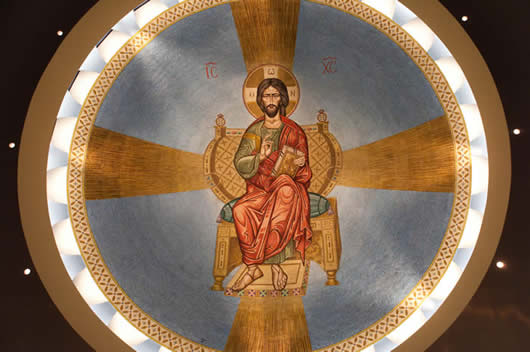
I chanced it. As we walked inside, I couldn’t help but look heavenward. There it was: a majestic rendering of Jesus pieced together with mosaic tiles. It covered the entire ceiling. I looked over at my daughters. For the first time all night, they were speechless. As they gazed upward, they were wrapped in the majesty of this image unable to be distracted by anything else. I could see awe in their eyes. Where we do find the space in our lives to experience awe?

I find that people today are angrier than we’ve ever been. We are angry at differing opinions. We are angry at the insults people lob at us.

In all candidness I have found myself angry the last couple of years over the issues of race in our country. I’m the first to admit I haven’t done enough in my own areas of influence to advocate for the fair and just treatment of African Americans in our society. I don’t understand how Caucasian/White people like me can’t empathize more with how hard it’s been and continues to be for African Americans in our country. I’m getting angry typing about it.

Last year, when there was a white supremacy march in Charlottesville, Virginia, I made a comment that Christians can never support this type of behavior. It’s our Christian witness to speak out against these forms of racism. I was surprised by how much resistance I received.

If I’m being true to myself, I got to tell you I have a hard time still going to Stone Mountain. I love that place. I have cherished memories there. But each time I walk up the side of that mountain, I can’t understand how our great state still lets Confederate Flags fly. I grew up in Jackson, GA. I witnessed the pain and hardships that my African American friends experienced that I will never know. Not ever! Ever!

I’m trying to be more empathetic with people who might be angered by such comments. I  admit it. I have had a pretty easy life growing up as an upper-middle class kid. My parents paid my way to college, my fraternity dues, my housing. I have had it pretty good. And I’m grateful. But that means I don’t know the bumps and bruises of blue-collar life and some of the feelings of displacement in a rapidly changing world. God knows I need more empathy and understanding. I confess how judgmental I can be.

I don’t want to be consumed by anger. It’s deadly and has put me squarely at odds with people I love. It makes enemies out of us! And I want peace and lots of it to spread around. In this coming Sunday’s scripture, we are looking at a passage from Psalm 8. The Psalmist took time to marvel in the majesty and awe of creation. The Psalmist sings,

You have given them dominion over the works of your hands; you have put all things under their feet all sheep and oxen,and also the beasts of the field, the birds of the air, and the fish of the sea, whatever passes along the paths of the seas. O Lord, our Sovereign, how majestic is your name in all the earth!

The Psalmist looks upon creation and nurtures adoration. Maybe in this season we need to nurture more time in the beauty of creation for God to repair our own brokenness. Awe can bring us out of the suffocating places of anger and into the realm of something more holy, more beautiful. And it’s only through this repair work that we can see the world rightly again.

I remember one of my previous neighbors. I would look outside my window into his yard. I would see him and his son peering through a telescope at the stars. I thought to myself, “I wish I had time for this.” I still have that wish.

We need some time to nurture awe into our lives. Watch a sunset. Gaze at stars. Get lost in a work of art. My hope is we can see that each of us has a part, broken as we are, in God’s mosaic.

This Sunday, we’re going to celebrate World Communion Sunday. We are celebrating the unity we find in Jesus Christ as we partake of the holy food of communion. Yes, there are differences in the Christian tradition. We are Catholic, Protestant, Greek Orthodox just to name a few. My hope is that as we lift the bread, we might more fully realize the unity we share as God’s beloved children. My hope is we might be able for a day, even for a second to see beyond the difference and stand in awe of our unique kinship as brothers and sisters in Christ.


Why can’t men help out with children’s church?

“Why can’t men help out with children’s church?” one mother lamented. Our church was down a children’s ministry intern for a season. We were needing more volunteers than usual to fill in the gaps. Many of our new mothers were picking up the volunteer load.  After a few weeks, it became evident that to keep this pace would mean that several of these moms would be missing church twice a month. They didn’t mind helping. They enjoyed serving the children. But as one of the volunteers said, “I feel like volunteering every other week! I’d like to hear the sermon too.”

Men! It’s time to man up! Churches need more men to serve in children’s ministry. We need to share the load with our women volunteers. Here’s the good news. You’ll love it!

I find it interesting that in the passage from Matthew 19:13-15, the disciples prevent the children from approaching Jesus. Maybe these male disciples were worried about working their first children’s church. Is it too much to assume that if the disciples in this scene had been women, the outcome would have been different? Either way, Jesus embraced the children and called his disciples to do the same. Long before children’s church was a thing, Jesus instructed men, “Help out with children’s church.”

A couple of years ago, the principal of Brookwood High School, Bo Ford, spoke to a group of men at their annual steak dinner (that’s a men’s gathering if I ever heard one). He talked about the ins and outs of being an administrator and the challenges of parents and staff. At the end of his talk, he opened the floor for conversation. Someone asked him, “What do you do to get away from it all?” He said, “Every Sunday morning at 9 a.m., I volunteer for the children’s ministry at my church. I work with the 3 year old class. Do you know the great thing about 3 year olds? They are glad to see you. They just want to know you care about them. I hear the complaints Monday through Friday from everyone else. There’s a parent wanting to contest their children unexcused absences. There’s a teacher who’s upset about a decision I’ve made. But on Sunday, the worse thing I might have to deal with is a child’s runny nose. I can’t wait for Sundays. ”

After he finished, I did an altar call for children’s ministry volunteer sign-ups. Men. It’s time to man up! God’s children need us!


Let the whistles blow. Welcome the sounds of children.

At a recent summer festival my 3 year old Bethany and 5 year old Katie each received a wooden duck whistle.  The organizers called it a “festival favor.” Isn’t there a law against this? Part of me thought, “Well, at least they gave us the whistle on the way in the festival instead of out. They’ll be on the ground in no time.” But they didn’t lose them. Why?  My children handed them to me while they watched the juggler on stilts. By the time they were riding the “Little Engine that Could,” they had forgotten about them. I had a little fun on social media. I took a picture of the whistles and commented, “The festival gave us whistles. They thought it was a good idea. The children have forgotten about them. I spot a trash can. What is the ethical thing to do?”

People responded with some funny lines:

“Set them free.”

And another, “I always look to my minister to help me decide on the big ethical choices of our day.”

But then came one comment from an empty-nester that hit me upside the head: “Enjoy the noise while it last. One day it won’t be there.”

How might we all learn to enjoy the noise of children?

If you’re like me, there are moments where the noise can seem like too much. There are the complaints about shoes not fitting right, tears over dad pouring a glass of water instead of milk and the screaming throughout the house as cousins give chase.

There are many mornings that I get up early for some quiet time before our children wake. It’s not terribly early, but it’s early enough. On most mornings, I get 27 minutes alone with my coffee and a devotion book (I have learned never to turn on the television. No matter how soft you keep it, they have the ears of an owl). But on some mornings, before the street lamps have turned off,  I hear the thump upstairs and I know it’s one of my daughters on a hunt for me.

Can I confess something to you? I sometimes keep it dark downstairs in those quiet minutes and refrain from taking sips of coffee. It never works.

The reality is that I know how indeed blessed I am to have the noise of children in my life. I love the sounds of laughter, running and chasing. On those days when it’s hard, I can’t get the thought out of my head: “Enjoy the noise. One day it won’t be there.”

This Sunday, I’m preaching on Matthew 19:13-15. There are children trying to approach Jesus. The disciples try to stop them. Children, in this day and time, were on the bottom wrung of society. They were hardly noticed.  Jesus says, “Let the little children come to me, and do not stop them; for it is to such as these that the kingdom of heaven belongs.” 

Jesus’ attitude towards children was one of embrace. He welcomed them and made them feel like they had a special place in God’s kingdom. He lifted them up as the example for how kingdom-minded people should live.

Welcoming the sounds of children (and youth) isn’t just about the laughter and cuteness. Although most children have a loving environment, many do not. They come from homes where parents fight. They have anxiety about bullying in schools. Teen-age cutting and self-harm is on the rise. The US department of education reports that 85 percent of all juveniles who interface with the juvenile court system are functionally illiterate. Many children are not loved to wholeness. They never received the type of care and concern God intended for them.

As we think about the role of the local church, we are reminded that we are part of God’s family. God does not define family by biology. God defines family by baptism. In the United Methodist Church we make a commitment to children at baptism. We promise that through our example the children will be “surrounded by steadfast love.” God has called the church to follow through on this commitment. The temptation for churches is to be concerned about the noise of children and the rambunctiousness of youth. Children will be loud. They’ll talk during worship. They’ll run in halls even though we tell them to slow down. They’ll hide under the table at Wednesday night dinners.

More importantly, children bring life. Their innocence questions remind us to sit and wonder at the stars. Their dependence on adults helping them eat their meals remind us how dependent we are on God’s providence. My wife and I were reading a children’s story to our oldest child about Rosa Parks recently. She asked us “Why were people so mean because of the color of her skin? I don’t understand.” I had a hard explaining it and how it still persists today. Children provoke us to think more critically.

Ultimately, they need us to surround them with steadfast love. God needs the church to live out what it’s great teacher taught. Let the children come. Let’s embrace their wiggles and volunteer our time for those youth gatherings. The kingdom of God is at hand when it comes to welcoming the children. My friend on Facebook was right. I say let the whistles blow.

I’m in no place to forgive.

“Pastor, there was a reason I had not been to church in three weeks” one church member told me years ago. When he said it, my mind raced for answers, “Was his mother in the hospital and I forgot to visit? Did I talk too much about money at the Wednesday night dinner?”

I said, “Ok, what was going on that made you miss the last three weeks?”

“It was your sermon topic.”

“Really? I have had people skip my sermon for other reasons, but it’s never been about the topic,” I said.

He said, “At the end of the service a month or so ago you mentioned  you were going to start a three-week series on forgiveness. I can’t stand a person in my life right now. I’m in no place to forgive. ”

I was surprised. Most people I have met struggle with forgiveness and they are looking to hear how to forgive. This man had been so deeply hurt that the thought of being asked to forgive kept him away. I was haunted by his statement: “I’m in no place to forgive.”

The more I have reflected on those words, the more I can call to mind others saying the same thing, just in a different way. I have heard questions and statements such as these:

“How do you forgive someone who won’t admit they’ve done anything wrong?”

“I might forgive, but I won’t forget.”

“How do you forgive someone who is dead?”

“Once I forgive a person, how can I make sure they don’t hurt me again?”

People find themselves saying in their own way, “I’m in no place to forgive.”

I confess that even as a minister steeped in learning about forgiveness, it’s hard for me too. This coming Sunday, I’m preaching on some of Jesus’ final words, “Father, forgive them for they do no know what they are doing” (Luke 23:34). To give some context, Jesus forgave the people who were jeering at him while he was hanging from a wooden cross. The savior of the world chose to use his final breath to forgive. If there ever seemed an appropriate time for a person to say, “I’m in no place to forgive” this was it!

Of course, we’re not Jesus. His power to forgive in the face of such brutality expressed the depth of mercy in the heart of God. God is a forgiving God. Even though we are not Jesus, we are not off the hook either. We are called to have the mind of Christ as Paul writes in Philippians 2:5. We strive to forgive because we are imitators of our Savior.

Forgiveness is a journey. Maybe some people can forgive at a moment’s notice. For most of us, forgiveness takes time. One of the most helpful analogies I can remember was offered by Pastor Adam (not Alexander) Hamilton of the Church of the Resurrection. In his message, he compared sins to rocks.

He began by showing the congregation a pebble. He likened the pebble to a slight jab or insult someone else might throw at you. A pebble-sized sin is when someone purposely calls you out in front of people. Usually, we can forgive people by day’s end.

He then showed a medium-sized rock, the size of a baseball. This rock represents those times a person lies and gets someone else in trouble. It represents the car beside you in traffic that cuts you off. These will hurt us for a day or two or maybe a week but most people can be like Taylor Swift and shake it off (I’ve officially met my pop-culture eye-roll quota).

He then went to the middle of the platform and uncovered the last rock. It was a four-foot tall boulder. The boulder represents the kind of sins that can get a person fired from work, end a marriage and send people to jail. To forgive people for these types of sins takes work! Adam Hamilton could not toss it to the side. He brought out a hammer and a chisel. He said that when the sin against you feels this heavy on your soul, forgiveness often means chipping away at it each day. To chip away means a prayer each day to ask God for power to forgive. To chisel away at forgiveness means finding the strength to stay in the same room as the other person. You take steps toward forgiving that person. One day, after you chipped away long enough through your faith in Christ, the boulder is gone and the weight lifted.

For instance, I remember this one young man years and years ago (we’ll call him Jim) who couldn’t forgive his father for walking out on him and his mother when we he was a teenager. Jim refused to invite his father to his birthday party. He never answered the phone when his dad called for Christmas. The wound was too deep. But Jim got involved in a Bible study at the church. He talked openly about his hurt and how he felt that if he had a relationship with his dad, he would be betraying his mother. Jim’s mother entered the conversation too. She was in no place to forgive Jim’s dad. In fact, she admitted wishing her ex-spouse were dead at times. Then she admitted her guilt for feeling this way and that really she didn’t mean it.

God was working. One day, out of the blue, she said to me, “I want Jim to feel like he can have a relationship with his dad. I’m willing to give it a try.” Jim confessed to his mother that despite the pain, he did want to know his dad. Jim and his mother started with a prayer each night. By Thanksgiving, Jim reached out by text and followed up with a phone call. One day, Jim’s mom came up to me and said, “Will, you’ll never believe this. Jim and his dad went to a football game the other day. They are developing a good relationship. I’m  happy about that.”

I asked, “That’s amazing! What about you? Have you forgiven Jim’s dad yet?”

She said, “Don’t push it. But I’m on the journey.”

Jesus is  a forgiving savior. His magnanimous spirit is one to emulate. How might we all start our forgiveness journey?


Go near the hurt

I’m preaching this Sunday on the Good Samaritan from Luke 10. I’ve been listening for a fresh word from this famous parable of Jesus. Maybe one of the reasons it’s so hard to preach it is that I have heard it so many times. But I’m thankful the Lord helped me hear it anew thanks to a commentary by Luke Timothy Johnson.

It’s important to remember the context of this parable. A lawyer is trying to trap Jesus with his questions about eternal life. Jesus asks him about the law. The lawyer responds that one should love God with all of your heart, soul, mind and strength and love your neighbor as yourself. The lawyer is quoting passages from Deuteronomy 6:5 and Leviticus 19:18. Jesus tells him to live out that commandment. Love God and neighbor. But the testy lawyer asks a question that echoes across the centuries: “Who is my neighbor?”

That’s a question I keep trying to answer for my own life. I wrestle with it every day. Jesus responds by telling him the parable of a man who fell among thieves on a dangerous road. When a priests sees the man he passes by on the other side. He was, I’m sure, running late to a conference on non-violence. The second man, a Levite, sees the man and he too passes by on the other side. But when the Samaritan man sees this man in the ditch, he comes close to the man and is moved with compassion. He binds his wounds and takes him to a local inn.

I could delve into the ethnic and cultural divisions of Jews and Samaritans. Suffice is to say they despised each other because of worship practices and the intermarrying of the Samaritans. But what strikes me more is what the Samaritan first chose to do. He chose to come close to the man in the ditch. The priests and the Levite see the man and refuse to come near him. They pass by on the other side. When the Samaritan man chooses to come near, it’s then he is moved with compassion. I can imagine the Samaritan witnessing this beaten man gasping for air, the flies buzzing around the blood on his ankles, the whelps on his neck from the robbers ripping off his shirt. Something happens in our guts when we go near the pain. To come near is a choice.

Several years ago, a church I served passed out summer lunches to children in apartment complexes who may not have had a lunch otherwise. The majority of the children were hispanic. They were lovely kids with bright smiles. As we wrapped up the program that summer, I wanted to invite the kids and their families to attend our church. One afternoon, I visited that apartment complex. I started knocking on the doors to asks the parents if we could pick up the children for church on Sunday mornings. To my surprise, no one was home. I must have knocked on 20 doors where there had been children just a week before. Finally, this older gentleman comes to me and says, “They’re not going to answer the door.” I said, “Why?  We’re just here to take them to church.” He said, “The parents think you’re an ICE agent and have come to take the children.” I looked again at those apartments and I could see eyes in the window.

For the first time, the hardships and complexity of immigration had a face. I felt something different that day. I felt compassion. That day, I didn’t pretend to have an answer for immigration in our country. I still don’t. But what I did experience in its fullest sense is the fear of the children. It broke my heart that on that day I was the source of their fear. “Who is my neighbor?”

It’s a question we all must answer for ourselves and for our communities. It’s not supposed to be an easy question. As we draw near to the pain, we’ll know better how Christ would have us respond.


Vulnerability and the Gospel

If you haven’t read the first blog post, I’m starting to keep a blog. This is not the first time I have tried. My hope is to keep it going at least a few months. I enjoy writing. Truth to be told, I worry nobody has time or interest to read it. And I’m not sure I have the time to engage much commentary on it either. As a parent, I’m distracted enough. But in the hope that a post or two might be helpful to some, here goes.

This Sunday in my sermon, I’m going to touch on the theme of vulnerability. How vulnerable are we willing to be? This sermon is a part of larger series on the life and ministry of Mr. Rogers. Mr. Rogers of all people was willing to help children learn the value of being honest with their vulnerable selves. He assured them it was ok to own their feelings. He let them know it was ok to be angry or sad or happy. We all have vulnerable parts we try to hide. At a surface level, I’m scared of dancing! I’m mortified! I have no rhythm. Think Elaine Benes dancing from Seinfeld (I just dated myself). I’m the one at the edge of the dance floor at a wedding waiting for them to finally play the one song I can dance to: The Macarena! Why is vulnerability so terrifying? It’s the thought or reality of being judged!

In the gospels, I’ll look at the character of Zacchaeus (what a pain to spell his name correctly) from Luke 19. The question I’m asking is “why did Zacchaeus climb the tree?” Sure he was short. The text says he climbed the tree in order to see Jesus. But I tend to feel like Zacchaeus didn’t just want to see Jesus. He also wanted Jesus to see him. For some reason, he knew Jesus could see all the vulnerable parts of his past, while also seeing the hope for his future. The crowds saw Zacchaeus the tax collector, Zacchaeus the corrupt public figure and Jesus saw that too. But Jesus saw more than Zacchaeus the sinner. Jesus also saw the future saint.

Have you ever felt at times like people don’t really see you? Maybe they notice you’re there, but it feels like you’re just part of the landscape. It feels like you blend in with the coffee table. It makes me think of theologian Dr. Greg Ellison whose opening line to his audience is always, “I’m glad to finally see you.” We need to finally see other, which can be frightening.

It requires a great deal of trust and faith to believe that Jesus can see us like he saw Zacchaeus. It means Jesus can see those addictive behaviors, those dashed dreams, those divided hearts. That’s probably why so many people feel shame over their spiritual journey. They fear the judgment of God more than they accept God’s love. But if Zacchaeus can teach us anything, it’s that Jesus cares more about our futures than about our pasts. He came to save the lost. That’s good news for each of us if we dare to open our vulnerable selves to the healing touch of Christ.

The Third Time’s the Charm

I have tried starting a blog twice before. I went a whole week on one of them. I hope this blog will help me learn more about my own thoughts by listening to them as I write and to engage you, the reader. As a pastor in the United Methodist Church, I love engaging my congregation in weekly sermons, but I want to have a written outlet too. I hope you enjoy. I’ll try to post once every couple of weeks, except for the first few weeks because I bet I’ll be posting much more to try to impress you.

“You have made us for yourself, O Lord, and our heart is restless until it rests in you.” St. Augustine of Hippo